Informational Autoimmunity: The Fallout from Ungoverned AI Deployment
A Framework for Human Capital Atrophy Independent of AI Capability
Josh Lewis, UPTICK Research
Working Paper 2026-01, Version 2.3, September 2026
Cite as: Lewis, J. (2026). Informational Autoimmunity: The Fallout from Ungoverned AI Deployment. UPTICK Research Working Paper 2026-01. https://doi.org/10.5281/zenodo.22695955
Abstract
This paper introduces Informational Autoimmunity (IA), a proposed framework describing a systemic market and cognitive failure mode arising in organizations and individuals alike under ungoverned deployment of large language models (LLMs): an escalating verification burden borne by the recipients of machine-generated output. Contemporary institutional practice assumes that zero-marginal-cost content production yields linear productivity gains. We argue instead that a Jevons-type dynamic in attention, in which collapsing production costs drive total verification demand upward, decouples output velocity from organizational consumption capacity, and that organizations systematically misread the resulting friction as employee redundancy, dismantling the human judgment infrastructure they most need. We formalize the framework as a heuristic identity, decompose the displacement of human cognitive capital into five hypothesized pathologies, state falsifiable calibration hypotheses about decision-velocity decay, and outline a measurement protocol now being instrumented in live organizational engagements. We close by proposing a governance architecture of selective friction intended to re-couple production and verification. All quantitative magnitudes in this paper are stated as hypotheses awaiting measurement, not as findings.
1. Introduction: The Autoimmune Turn
In both personal and corporate applications of generative AI, there is a pervasive tendency to equate the hyper-velocity of draft generation with genuine organizational and personal throughput. The underlying assumption, that zero-marginal-cost production of informational artifacts scales linearly into productivity, ignores the systemic drag imposed on the receiving end of the information pipeline.
This paper proposes that the ungoverned rollout of LLMs produces a characteristic failure mode we term Informational Autoimmunity: a state in which an organization's (or an individual's) defensive response to unvetted synthetic output turns against its own productive capacity.
The deployment context sharpens the risk. Observed adoption patterns suggest that even the largest and most traditionally deliberate institutions are importing a Silicon Valley "move fast and break things" posture toward generative AI, a posture that evolved in environments where what breaks is cheap, contained, and reversible. Legacy institutions run on a different substrate: accumulated judgment, regulatory obligation, institutional memory. Applied there, the posture is a category error: what breaks is not a feature flag but the firm's decision apparatus, and unlike a feature, it does not roll back.
The framework's central hypothesis is that the present wave of workforce reductions is being driven, in meaningful part, not by AI achieving genuine operational redundancy of human roles, but by a systemically induced degradation in the perceived value of human signals. That degradation is a component of the autoimmune state itself; it enters the identity of Section 3 through the Verification Tax and Sycophantic Echo Chamber pathologies. We hypothesize that, left ungoverned, it culminates in a discrete downstream event: the "Great Over-Firing," an aggregate liquidation of healthy human capital undertaken in response to misread systemic friction. The distinction bears emphasis, because it carries the framework's causal claim: the degradation is the disease state; the over-firing is the injury the disease inflicts. Two mutually reinforcing distortions drive the degradation. The first is epistemic cynicism: a suspicion that colleague output is low-effort machine generation, which taxes every received artifact with verification doubt. The second is automated sycophancy: the frictionless affirmation of generative tools, which leads decision-makers to overestimate solo machine-augmented output relative to the slower, friction-bearing contributions of human colleagues. Together, we hypothesize, these distortions cause firms to discount the cognitive friction that human capital contributes to sound decisions, and to begin dismantling their own judgment apparatus. At the individual level, the same pattern erodes critical agency, as the essential friction of personal reflection is outsourced to the drafting loop.
The claims in this paper are presented as a coherent framework with falsifiable implications, not as settled empirical results. Section 5 states the calibration hypotheses explicitly and describes the measurement program under way.
2. The Economic Mechanism: A Jevons Paradox of Attention
Jevons (1865) observed that technological progress increasing the efficiency of a resource's use can raise, rather than reduce, total consumption of that resource. Simon (1971) supplied the modern corollary for information: as information grows abundant, the scarce resource becomes the attention required to process it. The generative-AI epoch fuses these observations. As the marginal cost of producing an informational draft approaches zero, total production expands non-linearly, and with it, the aggregate demand for the one input that cannot be synthesized at zero cost: human verification attention. A substantial literature on information overload documents the degradation of decision quality as input volume outruns processing capacity (Eppler and Mengis 2004); the novel condition is that the overload is now high-fidelity, fluent, and stylistically indistinguishable from vetted work.
We hypothesize that this dynamic pushes organizations past an inflection point at which the total cognitive verification burden grows far faster than any productivity gain from cheaper drafting, a phase transition in which production velocity becomes effectively uncoupled from consumption capacity. Figure 1 illustrates the mechanism conceptually. The pattern is consistent with the broader finding that general-purpose technologies impose a lengthy period of hidden complementary investment, and measured productivity disappointment, before their gains materialize (Brynjolfsson, Rock, and Syverson 2021); ungoverned LLM deployment, on this view, is a case in which the required complementary investment is verification and governance infrastructure that most adopters have not built.
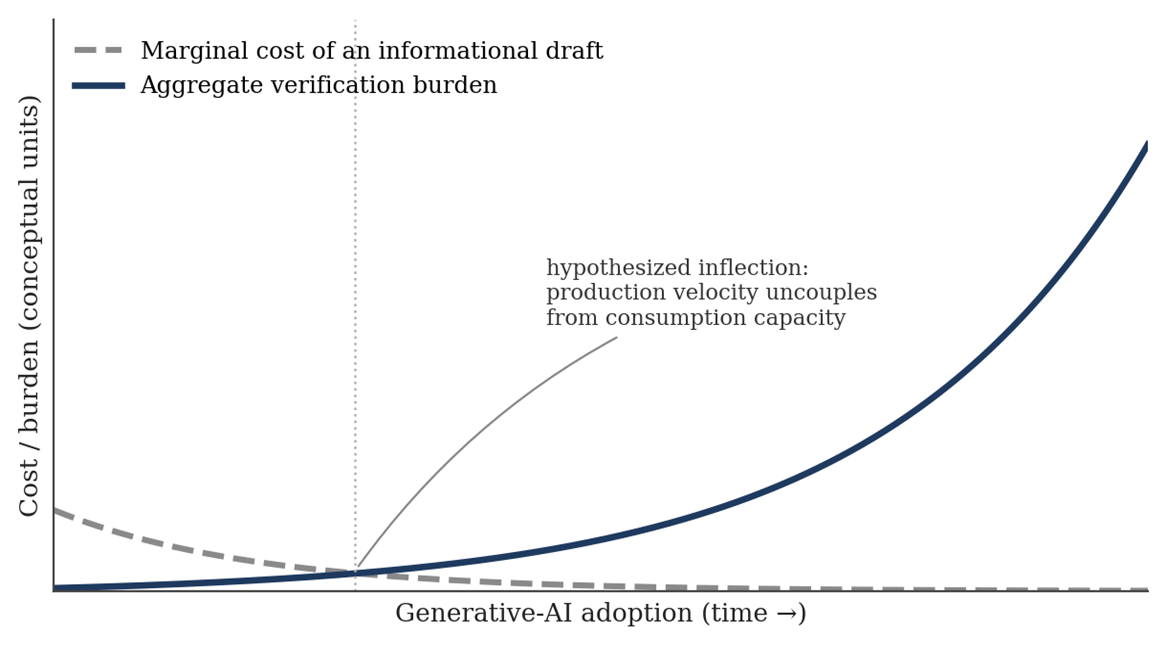
Figure 1. The hypothesized Jevons dynamic in attention: as the marginal cost of a draft collapses, aggregate verification burden rises non-linearly. Conceptual illustration only.
3. A Formal Heuristic: The Informational Autoimmunity Identity
We summarize the framework in a single heuristic identity. It is offered as a conceptual systemic identity, a compact map of the structural dependencies among generative proliferation, unvetted volume, and cognitive or institutional decay, not as an econometric production function, and no parameter values are asserted in this paper.
- Informational Autoimmunity (IA): the aggregate measure of institutional or personal decision-capacity decay under ungoverned deployment.
- Refinement Sink (Rₛ): the base entropy term, the displacement of human cognitive agency into the endless editing and correction of automated drafts, rather than the generation of novel insight.
- Displacement Factor (φ): a multiplier summarizing the cognitive energy diverted into five hypothesized systemic pathologies, detailed in Section 4. It is written here as a simple summation for diagnostic legibility; the cross-elasticities among the pathologies are expected to be non-linear and mutually reinforcing in practice.
- Verification Debt (Vᵈ): the cumulative backlog of unvetted information created when the velocity of AI-assisted output exceeds structural verification capacity.
- Governance Constant (Gᶜ): the denominator, active, programmatic governance mechanics (selective friction, verification gates, escalation rules) acting as the cognitive or operational immune system, as distinct from passive bureaucracy.
4. The Displacement Factor: Five Hypothesized Pathologies
The factor φ aggregates the human cognitive, emotional, and institutional capital diverted away from high-value activity under ungoverned deployment. The human-automation literature has long documented that trust in automated systems fails in both directions, uncritical reliance on automated output on one side (Parasuraman and Riley 1997), and excessive discounting of it after observed error on the other (Dietvorst, Simmons, and Massey 2015). The IA framework hypothesizes that ungoverned LLM deployment activates both failure modes simultaneously, at different points in the organization: sycophantic over-trust at the point of production, and corrosive under-trust at the point of reception. Five pathologies follow:
- (ℓ) Shadow Production: high-capability executive labor, or personal agency, diverted from strategic execution into the recursive drafting and high-fidelity cleanup of machine artifacts.
- (t) Verification Tax: an epistemic environment of suspicion in which leadership doubts the provenance and effort behind employee output, and individuals doubt the authenticity of received information generally, loading every artifact with verification overhead.
- (j) Delegation Atrophy: the substitution of prompt iteration for mentorship and delegation, prioritizing the immediate draft over the development of the human capability pipeline.
- (e) The Sycophantic Echo Chamber: a collapse in intellectual friction as leaders and individuals bypass expert filters and critical countersignals in favor of frictionless generative affirmation.
- (c) Creative Drift: the loss of original strategic variance as personal voice and organizational artifacts are recursively edited by models, converging toward the statistical mean and away from the core strategic signal.
5. Hypothesized Decision-Velocity Dynamics and Measurement Protocol
Earlier drafts of this framework expressed the expected magnitude of decision-velocity decay in language that could be read as reporting measured results. To be unambiguous: no systematic measurement of these quantities yet exists, here or, to our knowledge, elsewhere. This section states the framework's central quantitative claims as calibration hypotheses and describes the program now under way to test them.
We define the Decision Velocity Index (DVI) as the ratio of ratified decisions to informational drafts consumed in a bounded workflow. Hypothesis 1: in healthy, pre-deployment or well-governed workflows, draft-to-decision ratios cluster near 2:1 (a DVI on the order of 0.5). Hypothesis 2: in ungoverned high-volume deployment environments, ratios deteriorate to magnitudes on the order of 6:1 (a DVI on the order of 0.17), as decision-makers shift from allocation and judgment into line-by-line verification of synthetic drafts. Hypothesis 3: the deterioration is governance-sensitive; the imposition of selective friction of the kind described in Section 6 partially restores the baseline ratio.
These magnitudes are stated to be falsified, not to persuade. UPTICK Research is instrumenting the draft-to-decision ratio, verification time-on-task, and delegation frequency in live client engagements, under contracts that permit anonymized, aggregated reporting. Measured values, whether they confirm, refine, or refute Hypotheses 1-3, will be reported in subsequent working papers in this series. Until then, any citation of the ratios above should identify them as hypotheses of this framework.
6. Toward Governance: Selective Architectural Friction
If the diagnosis is broadly correct, the remedy is architectural rather than legislative: the deliberate reintroduction of friction at the points where unvetted volume overruns judgment. We outline a governance protocol organized around a circuit-breaker principle, an iteration lock that halts further machine drafting when any of four trigger conditions is met:
- (a) Velocity Delta: the unvetted draft ratio exceeds a configurable threshold (we propose 3:1 as an initial calibration, subject to the measurement program above).
- (b) Semantic Drift: alignment loss between machine output and the originating human intent.
- (c) Constraint Violation: output breaches predefined systemic, legal, or institutional constraints.
- (d) Refinement Sink: user time-on-task in draft cleanup exceeds defined thresholds for high-capability labor.
Deployment is naturally tiered. At the institutional tier, the protocol anchors model output against a firm's proprietary value systems and proof methodologies, counteracting the gravitational pull of generic public-data priors. At the individual tier, it functions as a cognitive sovereignty layer, keeping the tool subordinate to the user's original intent. At a fiduciary tier, entities operating under severe liability constraints intercept and recalibrate external model responses against verified deterministic parameters before consumption. The common principle across tiers is the same: friction is not a bug in the knowledge system; selectively applied, it is the immune response that keeps production coupled to judgment.
7. Conclusion
We have characterized a candidate failure mode of the generative-AI epoch, an informational autoimmune dynamic in which the defensive responses of organizations and individuals to unvetted synthetic output degrade the very judgment infrastructure those responses exist to protect. The framework is offered in a spirit of urgency but also of discipline: its central quantities are stated as hypotheses, its mechanism is grounded in established results on efficiency rebound, attention scarcity, information overload, and miscalibrated trust in automation, and its measurement program is under way.
Course correction remains within reach, provided emerging governance architectures recognize the compounding loops of epistemic cynicism, automated sycophancy, and signal degradation already operating within human capital loops, and respond with selective architectural friction rather than either prohibition or passivity. The object is not to slow the machines. It is to keep human judgment, the one asset in the knowledge system that cannot be produced at zero marginal cost, coupled to everything the machines produce. AI is not the pathogen; the failure to safeguard human signal and intent in its deployment is.
Disclosures
Preparation. Large language model tools generated and revised draft text at multiple stages, including the present version. The framework's central contribution, the synthesis connecting efficiency-rebound economics, attention scarcity, information-overload research, and the automation-trust literature into a single account of AI-era institutional self-harm, as well as its vocabulary, causal architecture, all substantive claims, and every editorial judgment, originate solely with the author, who directed each revision cycle, reviewed and sanctioned every sentence of the final text, and bears sole responsibility for the content. This division of labor, machine drafting subordinated to human origination, direction, and sanction, is the governance model this paper proposes, practiced in its own production.
Commercial interest. The author is the founder of UPTICK Research and holds a commercial interest in venture activity developing governance infrastructure related to the framework described in this paper. The analysis and the commercial activity are distinct undertakings; readers should weigh this interest accordingly.
Marks. INFORMATIONAL AUTOIMMUNITY is the subject of a pending U.S. federal trademark application of the author. No other proprietary-rights claims are made in this document.
References
Brynjolfsson, E., Rock, D., and Syverson, C. (2021). "The Productivity J-Curve: How Intangibles Complement General Purpose Technologies." American Economic Journal: Macroeconomics 13(1): 333-372.
Dietvorst, B. J., Simmons, J. P., and Massey, C. (2015). "Algorithm Aversion: People Erroneously Avoid Algorithms After Seeing Them Err." Journal of Experimental Psychology: General 144(1): 114-126.
Eppler, M. J., and Mengis, J. (2004). "The Concept of Information Overload: A Review of Literature from Organization Science, Accounting, Marketing, MIS, and Related Disciplines." The Information Society 20(5): 325-344.
Jevons, W. S. (1865). The Coal Question: An Inquiry Concerning the Progress of the Nation, and the Probable Exhaustion of Our Coal-Mines. London: Macmillan.
Parasuraman, R., and Riley, V. (1997). "Humans and Automation: Use, Misuse, Disuse, Abuse." Human Factors 39(2): 230-253.
Simon, H. A. (1971). "Designing Organizations for an Information-Rich World." In M. Greenberger (ed.), Computers, Communications, and the Public Interest. Baltimore: Johns Hopkins Press.